
How Do Metal Detectors Work? VLF, Pulse Induction and Pinpointers
A metal detector sends out a changing magnetic field and listens for the field a metal object sends back. VLF, pulse induction and a pinpointer each handle that signal differently.
The Quindrel Team
November 14, 2026 · 8 min read

How do metal detectors work? A transmitter coil sends a changing magnetic field into the ground, metal objects in that field produce a small field of their own, and a receiver coil picks it up and turns it into a tone or a display reading. The main designs, VLF and pulse induction, differ in how they send and read that signal.
This guide connects the physics to the choices you make in the field: which technology suits which ground, which metals show up, why targets get missed, and where a pinpointer fits.
How do metal detectors work: the physics in four steps
Inside the search coil are wire windings. The control box sends an alternating electric current through the transmitter winding, and that current creates an electromagnetic field that reaches into the soil, sand or water below the coil.
- The transmitter winding produces a changing magnetic field.
- When the field crosses a conductive object, it drives swirling eddy currents inside that object.
- The eddy currents create a second, weaker magnetic field around the target.
- A receiver coil senses the change, and the control box converts it to audio tones, a visual reading or both.
This is how a metal detector works at its core. It does not sense metal directly. It senses how a conductive object disturbs the field the coil is already sending out.
Ferrous and non-ferrous targets
Ferrous metals, such as iron and steel, contain iron and are magnetic. Non-ferrous metals, such as copper, silver, brass and aluminum, are not. Both disturb the field, but they do so in different ways, and that difference is what discrimination circuits use to tell target types apart.

VLF, pulse induction and multi-frequency compared
The technology inside the control box decides how the signal is sent and read. Three designs cover most hobby detectors.
| Technology | How it transmits | What it is known for | Where it is used |
|---|---|---|---|
| VLF (very low frequency) | Continuous sine wave at one frequency, with separate transmit and receive windings | Reads how the target shifts the signal, which allows discrimination | Parks, fields, trails, dry sand |
| Pulse induction (PI) | Short bursts of current, then it listens to the decay of the returning signal | Little discrimination, but the pulse is not thrown off by ground minerals the way a continuous wave can be | Mineralized ground, wet salt sand, shallow water |
| Multi-frequency | Transmits several frequencies together or in sequence | Covers small and large targets in one pass | Mixed ground and varied targets |
Why VLF can sort metals
A VLF detector compares the sent signal with the returning one. Different metals shift the timing, called phase, by different amounts. The control box uses that shift to estimate whether a target looks like iron, a pull tab or a coin, and discrimination mode can then silence the tones you do not want.
Why pulse induction handles minerals differently
A PI detector sends a pulse, switches off, and measures how long the target's eddy currents take to fade. Ground minerals and salt water produce a steady background, so PI can be tuned to ignore it. The tradeoff is that the single decay reading gives little information about what the metal is, so you dig more of what you find.
What sets off a metal detector, and which metals it misses
Any electrically conductive object can set off a detector, because conductivity is what allows eddy currents to form. So no, not all metal reacts the same way. Response depends on the metal, the size and shape of the object, its depth and its angle under the coil.
| Target | Type | What to expect |
|---|---|---|
| Iron and steel nails | Ferrous | Strong response, often a low or broken tone in discrimination |
| Copper and brass | Non-ferrous | Good conductors, so they give a clear signal |
| Silver | Non-ferrous | Highly conductive, so a thin coin still responds |
| Gold | Non-ferrous | Lower conductivity, so small pieces give a weak signal |
| Aluminum foil and pull tabs | Non-ferrous | Thin or small pieces give a faint or mid-range signal |
| Lead | Non-ferrous | Low conductivity, so it can read faintly |
| Stainless steel | Varies by alloy | Response varies with the alloy |
| Plastic, glass, wood, stone | Not metal | No response on their own |
That table also answers which metals a detector can miss. No common metal is invisible in principle, but a tiny, deep or low-conductivity piece can sit below the detection threshold. Non-metals do not respond at all unless they contain metal, such as a ring in a glass jar.
How a detector finds gold
Gold is a conductor, so it forms eddy currents like any other metal. Small nuggets and thin jewelry are the challenge: they have little mass, and gold's conductivity is lower than silver or copper. Detectors made for gold hunting are tuned to respond to small, low-conductivity targets, often at higher frequencies.
Ground minerals add to the difficulty. Mineralized soil produces its own signal that can overwhelm a faint nugget, which is why ground balance, a control that tunes out the soil signal, matters more for gold than for coins. If you plan to filter junk, note that discrimination can also reject small gold, since a tiny gold ring and a pull tab can read alike.
Why targets get missed
When a detector stays quiet over a buried object, the cause is usually one of a few physical limits.
- Depth: the field weakens quickly with distance, so a small object deep down returns almost nothing.
- Size and coil match: a large coil reaches further but is less responsive to tiny items, and a small coil does the reverse.
- Mineralization: iron-rich or salty ground sends back signals that mask faint targets.
- Discrimination masking: a good target sitting next to iron junk can be rejected with the junk.
- Sweep technique: raising the coil at the end of a swing, or sweeping too fast, leaves gaps in coverage.
- Orientation: a flat coin lying on edge presents a different shape to the field.
Lowering discrimination, slowing the swing and overlapping each pass address most of these. The coil must also stay close to the ground, since its field is strongest near the windings.
Field note
Before you trust a quiet signal, sweep the same spot from two directions. A target that is deep, tilted or beside iron often answers from one side only.
How a pinpointer complements the main detector
A main detector tells you a target is somewhere under a coil that is several inches wide. After you cut the plug and open the hole, the target may still be hidden in the loose soil. A pinpointer is a small handheld probe that works on a similar principle but detects at close range, so it narrows the search inside the hole and the pile of dirt.
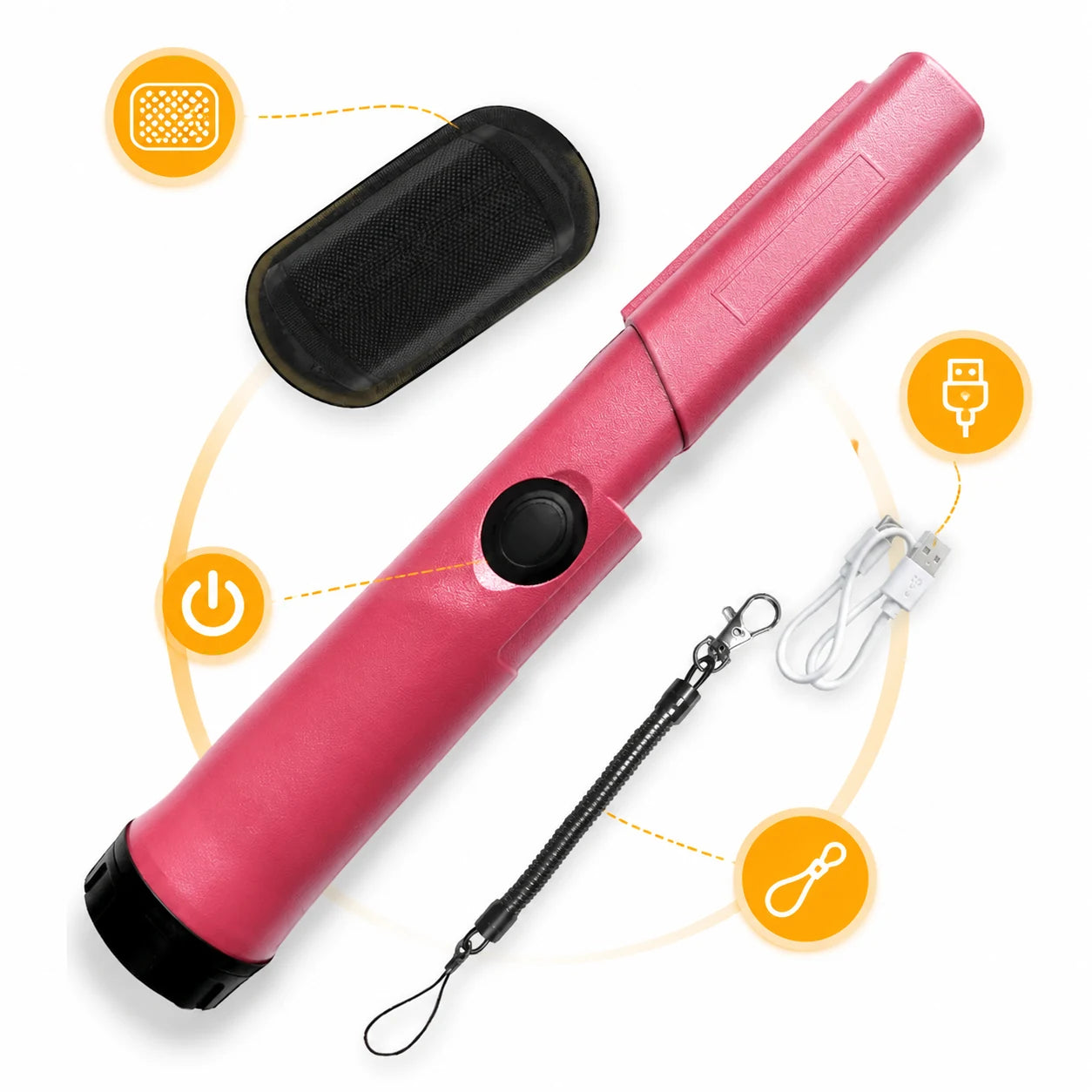
ProbeStrike is built for that job. It has a single button for power and sensitivity, three sensitivity levels shown by LED, and audio and vibration alerts as the tip nears a target. Its probe detects at the tip and along its sides, so you sweep it around the hole instead of aiming it.
 In this guideProbeStrike$189.99View
The three sensitivity levels let you set the probe for the ground you are digging in, such as a trashy park, clean sand or a mineralized creek bed. It charges through a USB-C cable, so there is no 9V battery to carry or swap out, and a belt holster with a lanyard loop is included.
Choosing a detector for the beach
Sand adds two problems: salt moisture, which conducts electricity and confuses a continuous-wave signal, and constant trash such as bottle caps and pull tabs. Dry sand suits most designs, while wet salt sand at the wave line is where pulse induction is used. Our guide to metal detector beach hunting covers settings, spots and sweep technique in detail.
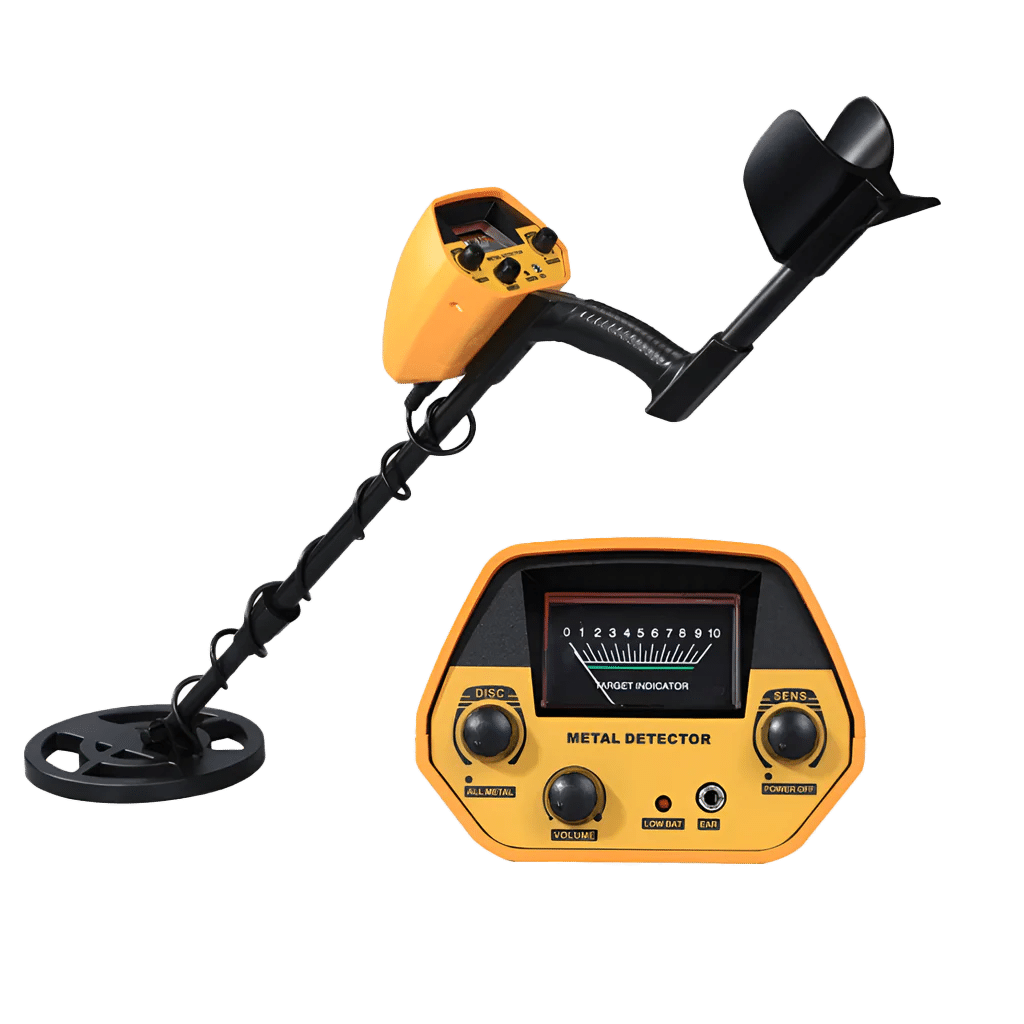
GleamCoast is a beach metal detector with an adjustable stem, a padded armrest and a search coil. You sweep the coil low over dry sand, wet sand, soil or shallow water while the control housing stays above the waterline. It signals a target with audio tones and a visual pinpoint display, and you use both together to decide where to dig. Its discrimination mode lets you filter signals from items such as bottle caps and pull tabs when you want to focus on targets like gold or silver. It runs on two standard 9V batteries.
 In this guideGleamCoast$119.99View

Other places metal detectors work: security, food and industry
Walk-through and handheld security detectors use the same induction idea. A field is sent through a doorway or wand, and conductive objects disturb it. Operators set the sensitivity so that small items such as belt buckles and keys are handled according to the site's screening rules.
Food and industrial lines run products past a coil that detects stray metal fragments. A conveyor passes through the coil opening, and a disturbance triggers an alarm or rejects the item. The physics matches the field detector, with the coil fixed in place and the target moving.
Setup checklist and common mistakes
- Install fresh batteries and check that the stem, rod and coil are connected before you start.
- Set the stem length and armrest to your arm, as the manual describes.
- Start with discrimination off or low, so you hear every target.
- Keep the coil low and level, and overlap each sweep.
- Move any metal watches, rings or boot hardware away from the coil, since they can trigger it.
- Dig, then scan the hole and the pile with a pinpointer.
Common mistakes are heavy discrimination in the first pass, a swing that lifts at the end, and skipping a test target. Place a known coin on the ground and sweep it to learn how your tones sound.
For more tools that measure and detect, browse the Precision Measuring & Detection Tools collection.
Frequently asked questions
Keep reading
 Precision Measuring & Detection ToolsMetal Detector Beach Hunting: Settings, Spots and Technique6 min read
 Inspection Cameras & ScopesVideo Borescopes: How They Work and How to Use One on a Car7 min read
 Weather, Air & Moisture MetersHow Does a Moisture Detector Work? Readings and What Skews Them9 min read