Why Is Your Car AC Not Blowing Cold Air? Step-by-Step Diagnosis
Low refrigerant, a compressor clutch that will not engage, a blown fuse or a stuck blend door can all be the cause. Check them in order and see what is DIY and what needs a shop.
The Quindrel Team
October 30, 2026 · 7 min read

If you are asking why your car AC is not blowing cold air, the cause can be low refrigerant from a leak, a compressor clutch that is not engaging, a blown fuse or bad relay, a blocked condenser, or a blend door stuck on heat. Work through the checks below in order. The first few cost nothing and need no tools, and the later ones tell you when to hand the car to a shop.
This guide covers what you notice, the order to check things, and a clear line between DIY work and repairs that need refrigerant reclaim equipment.
Why Is Your Car AC Not Blowing Cold Air: The Short List
Match what you notice to the likely cause, then jump to the step that covers it. If your car AC is not blowing cold air today, start at the top of the table and move down.
| What you notice | Likely cause | First check | DIY or shop |
|---|---|---|---|
| Weak airflow, any temperature | Clogged cabin filter or failing blower | Filter, fan speeds | DIY |
| Fan works, air is warm, no click from engine bay | Fuse, relay, or compressor clutch | Fuse box, clutch | DIY check, shop for clutch or compressor |
| Cold at first, then warm | Low refrigerant, icing, or a clutch cycling | Clutch behavior, leak scan | DIY scan, shop for repair |
| Cool on the highway, warm in traffic | Condenser fan or blocked condenser | Fan spin, debris on condenser | DIY look, shop for fan motor |
| Hot on one side, cold on the other | Blend door actuator or low refrigerant | Ticking behind the dash | Often shop |
| Sudden loss of cold | Blown fuse, failed relay, or a fast leak | Fuses, then leak scan | DIY check, shop for leaks |
Before You Start: Controls, Airflow and Condenser
Park on level ground, set the parking brake, and open the hood. Keep hands, loose sleeves and cables clear of the belt and the cooling fans whenever the engine is running, and follow your owner's manual for anything under the hood.
Find the refrigerant type on the label under the hood or in the manual. Cars use R134a or R1234yf depending on model, and the two are not interchangeable. Refrigerant handling is regulated, so leave reclaiming and recharging to a shop.
Check the controls
Set the system to the coldest setting, fan on a middle speed, recirculation on, and the A/C button lit. It sounds obvious, but a mode set to defrost or a dial left on heat explains more than you might expect.
Judge the airflow
If the air is weak at every fan speed, replace the cabin air filter, which sits behind the glove box on many vehicles; the manual shows where. If the fan does not run at any speed, the problem is the blower motor, its resistor or a fuse, not the cold side of the system.
Look at the condenser
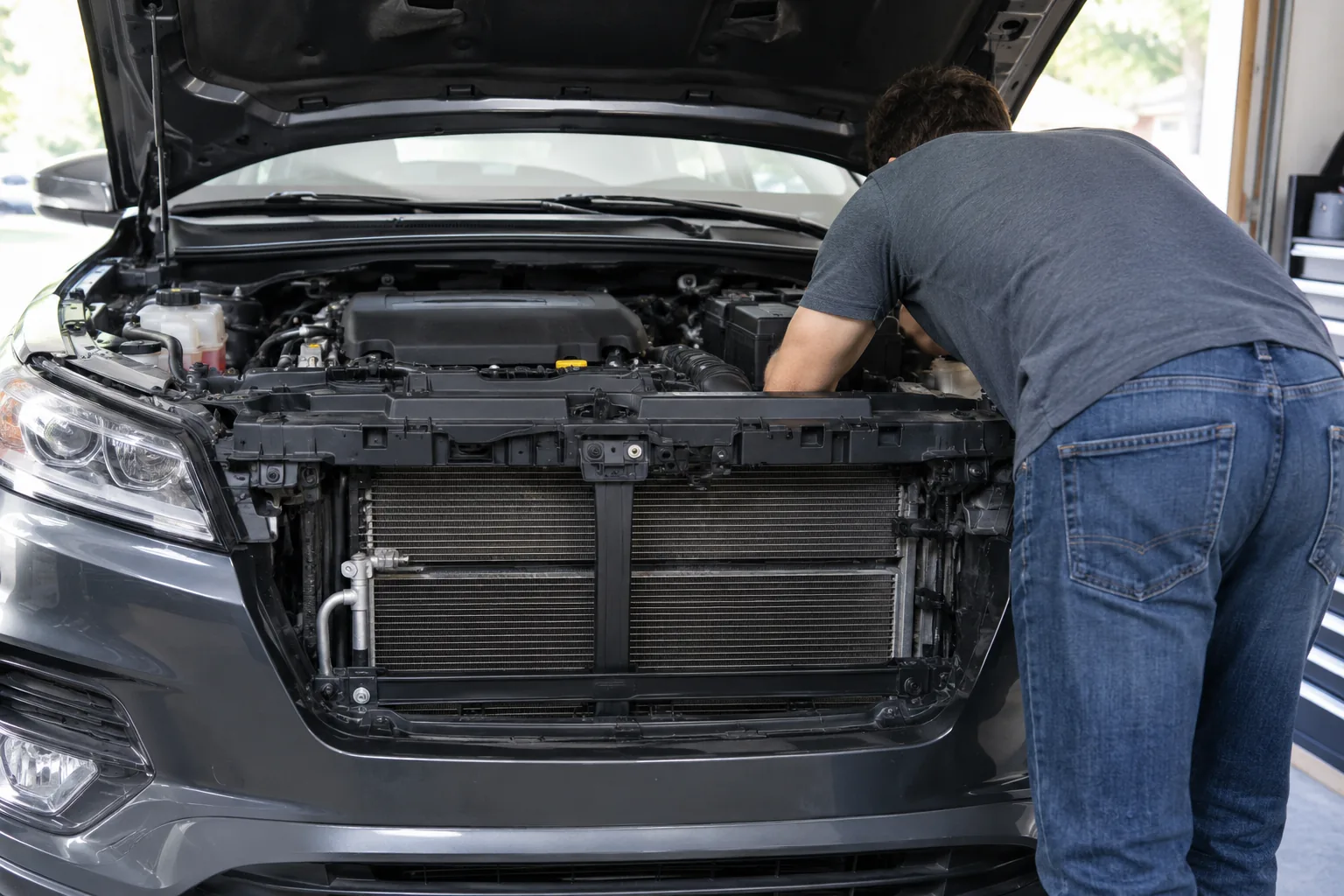
The condenser sits in front of the radiator. Leaves, bugs and road debris packed into its fins block the airflow it needs to shed heat. Rinse it from the front with low-pressure water, spraying along the fins, not across them, so you do not bend them.
Fuses, Relays and the Compressor Clutch
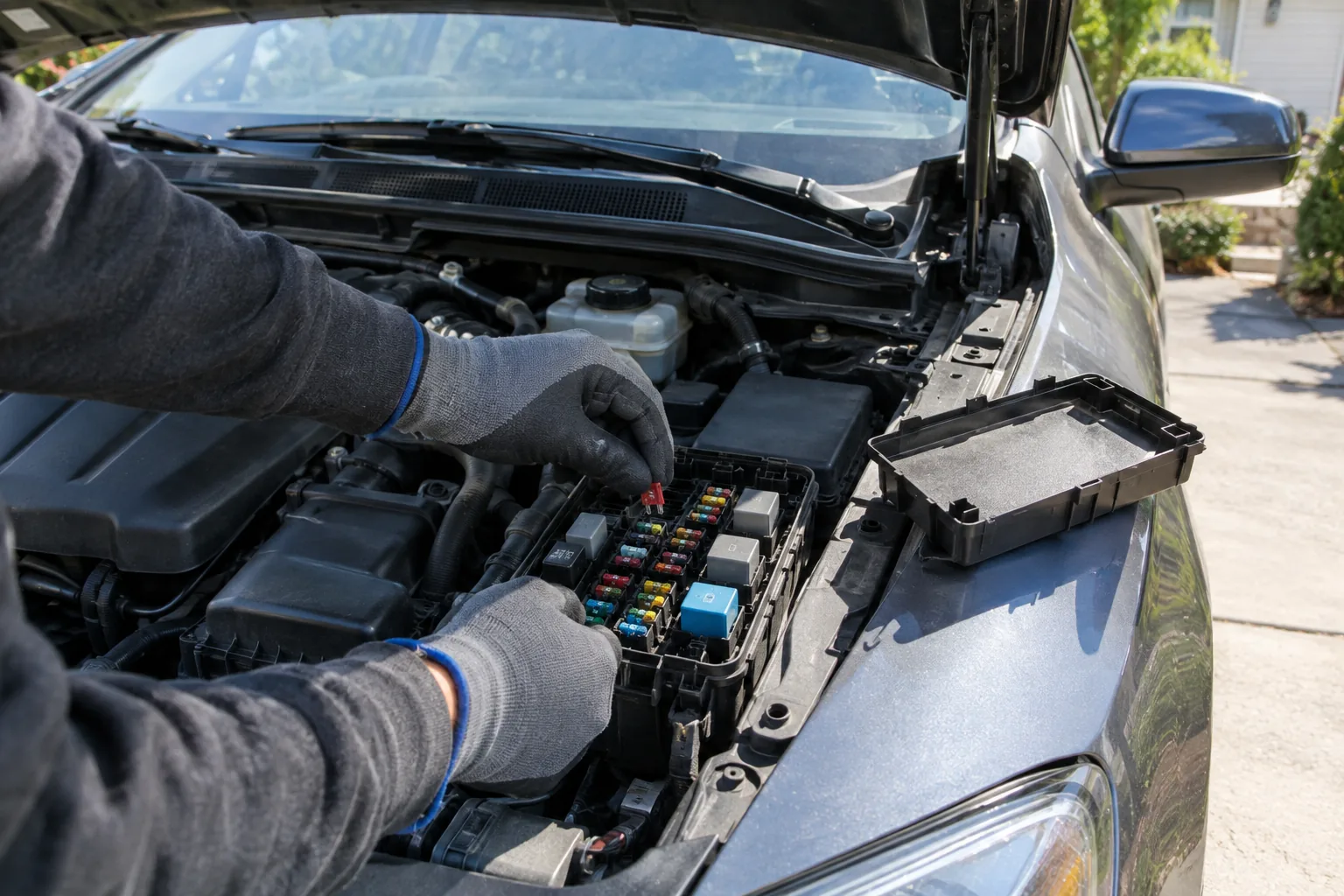
A sudden loss of cold with no click from the compressor points to electrical trouble. Use the diagram in the manual to find the A/C compressor fuse and relay in the under-hood fuse box.
- Switch the engine off and remove the fuse with a fuse puller.
- Hold it to the light. A broken metal strip means it has blown.
- Install a new fuse of the same amperage. A higher rating is not a fix.
- If the new fuse blows again, stop. A short in the circuit needs a technician.
For the relay, you can swap it with an identical relay from a circuit the manual lists, such as the horn. If the A/C starts working, replace the bad relay.
Watch the compressor clutch
With the engine running, A/C on and fan on high, look at the front of the compressor. The outer pulley always spins with the belt. The center plate, the compressor clutch, should click in and spin with it.
- Clutch engages and holds: the electrical side is working. Move on to refrigerant and the blend door.
- Clutch cycles on and off rapidly: this often points to low refrigerant tripping the pressure switch.
- Clutch does not engage: check the fuse and relay again, then the pressure switch and clutch coil. Low refrigerant can also keep the clutch from engaging on purpose, to guard the compressor.
Replacing a clutch, coil or compressor means opening the sealed system, so that part belongs in a shop.
Find Out Whether Refrigerant Is Leaking
The A/C is a sealed loop, so low refrigerant means a leak somewhere. Adding refrigerant without locating the leak only delays the repair, and overfilling causes its own problems. Locating the refrigerant leak is the useful DIY job here.
First, look for oily, dirty residue at hose crimps, fittings, the compressor body and the condenser. Refrigerant oil carries out with the leak and collects dirt. Then scan the same places with an electronic detector.
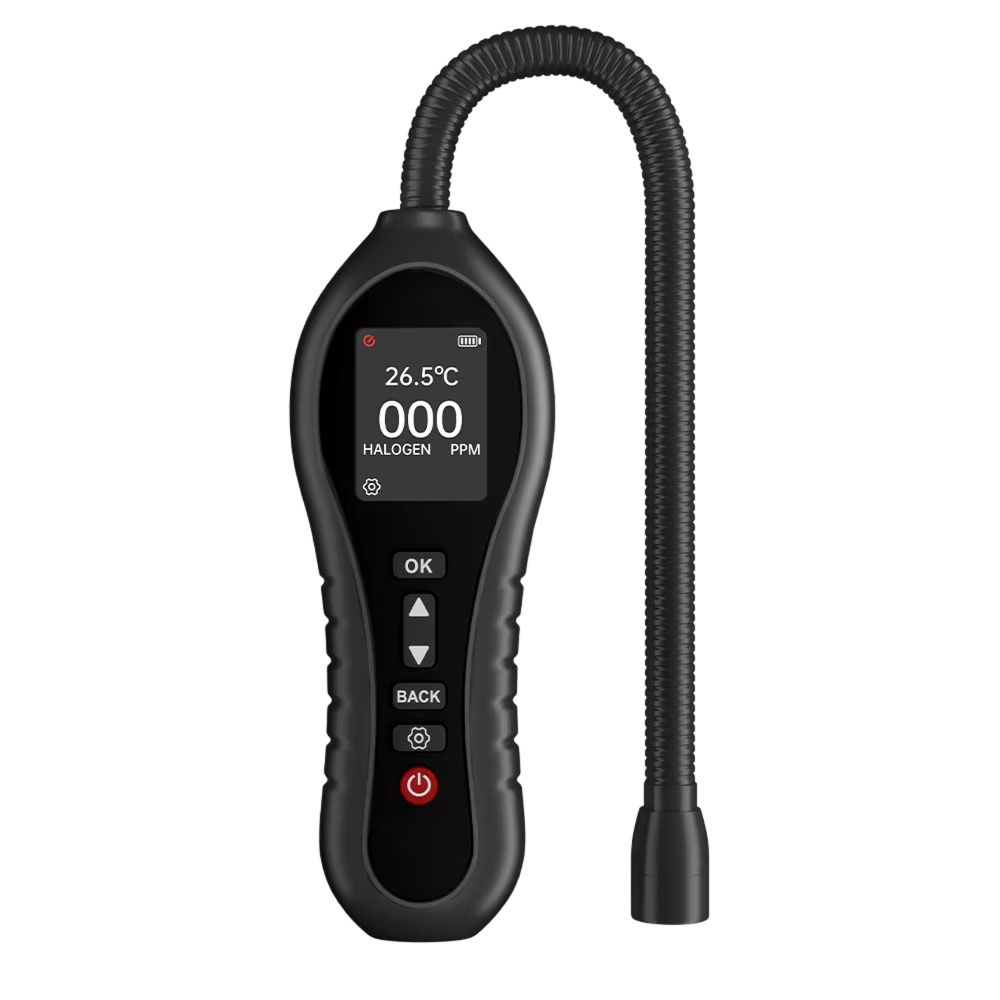
The LeakHawk Pro is a handheld refrigerant leak detector with an infrared sensor, so it reads refrigerant optically rather than with a heated tip. It is listed for R134a and R1234yf, among other refrigerants. Bend the 9.44-inch (about 24 cm) probe to reach behind coils and into cramped bays, and sweep it slowly along each line and fitting. The beeper speeds up and the LCD changes as you near a leak, and the strongest alert marks the spot to inspect. The controls are sized for gloved hands.
 In this guideLeakHawk Pro$129.99View
Field note
Write down where the detector alerts (fitting, condenser, compressor seal) and hand that note to the shop. A named leak point gives the technician a place to start.
Blend Door and Engine Codes
Hot on one side, or stuck on heat
If one side of the cabin blows warm and the other cold, or the temperature does not change when you turn the dial, suspect a blend door actuator. This small motor moves the door that mixes air across the heater core. A failing one often ticks or clicks behind the dash when you change the temperature.
Listen with the engine on and switch between full cold and full hot. If you hear clicking and the temperature does not follow, the actuator or its door is the likely cause. Some actuators sit under the glove box within reach of a screwdriver set; others need the dash opened, which is shop work. Low refrigerant can also cause uneven temperatures on dual-zone systems, so a leak scan is still worth doing.
Read codes and live data
Warm air can also come from the engine side. A car that runs hot or has a failing coolant sensor may shut the A/C off to reduce load. A scan tool shows whether the engine has stored codes that point that way.
The DriveDecode is a standalone handheld scan tool with a backlit color screen. It plugs into the 16-pin OBD2 port of cars and trucks built from 1996 on. Turn the ignition to ON without starting the engine, choose Read Codes to see pending, stored and permanent codes, then open Live Data to watch values such as coolant temp and battery voltage. For help reading the numbers, see our guide to using a car code reader. You can also browse the Audio, Connectivity & Diagnostics collection.
 In this guideDriveDecode$99.99View
When It Is Only Cold Sometimes, or Only on Hot Days
Heat makes every weakness show. On a hot day the system has to reject more heat through the condenser, so a partly blocked condenser, a condenser fan that does not spin, or a small refrigerant shortage can leave the air merely cool.
- Cool when moving, warm at idle: check that the electric condenser fan turns with the A/C on.
- Cold, then warm, then cold again: moisture can freeze at the evaporator, or the clutch may be cycling on a low-pressure signal.
- Humid air blowing weak: an iced evaporator restricts airflow until it thaws. Turn the A/C off, run the fan, and see if airflow returns.
These patterns point to the part to check, not to a confirmed fault, so combine them with the clutch and leak checks above.
What to Fix Yourself and What to Send to a Shop
| Job | DIY | Shop |
|---|---|---|
| Controls, cabin filter, condenser rinse | Yes | No |
| Fuse and relay swap | Yes | If the fuse keeps blowing |
| Watching clutch behavior | Yes | For replacement |
| Leak scan with a detector | Yes | For repair and recharge |
| Reading engine codes | Yes | For complex faults |
| Compressor, condenser, hoses, evaporator | No | Yes |
| Blend door actuator | Some vehicles | If the dash must come out |
Anything that opens the sealed system needs reclaim equipment and a vacuum pump, so a shop handles it.
Common Mistakes
- Adding refrigerant from a can before finding the leak, then repeating it each season.
- Fitting a higher-amp fuse to stop one from blowing.
- Mixing refrigerant types or oils. Match the label under the hood.
- Skipping the cabin filter and condenser, the lowest-cost checks on the list.
- Running the compressor with the system empty, which can damage it.
Work in the order given: controls, fuses, clutch, leaks, blend door, codes. Each step rules out one branch, and you arrive at the shop knowing which one is left.