
What Is Barometric Pressure and How to Read It on a Meter
Barometric pressure is the weight of the air above you. Learn the units, what counts as high or low, how to read the trend, and how altitude shifts the number.
The Quindrel Team
October 30, 2026 · 6 min read

Barometric pressure is the weight of the air column above you, pressing down on every surface. It is also called atmospheric pressure, and it is highest at sea level and falls as you climb. A handheld meter reads it in units such as hectopascals, millibars or inches of mercury, and the direction it moves tells you more about the coming weather than any single number.
This guide explains the units, what counts as high or low, how to read a trend, and how altitude changes the number on your display. It covers the weather and instrument side only.
What Is Barometric Pressure?
Air has mass, and the layers of air stacked above a spot push down on it. That push is the answer to what is air pressure in plain terms: force from air, spread over an area. When you ask what is pressure of air outdoors, it means this same force at the ground.
Weather changes it. Warm, rising air tends to lower the pressure at the surface, while cool, sinking air tends to raise it. That is why a barometer, an instrument that measures this force, is a standard tool for weather watching.
How barometers measure it
A mercury barometer balances the air's weight against a column of liquid in a glass tube. Aneroid barometers use a sealed, flexible capsule that flexes as pressure changes. Digital handhelds use a solid-state sensor that converts pressure into an electronic signal. All three answer the same question, so you read them the same way.
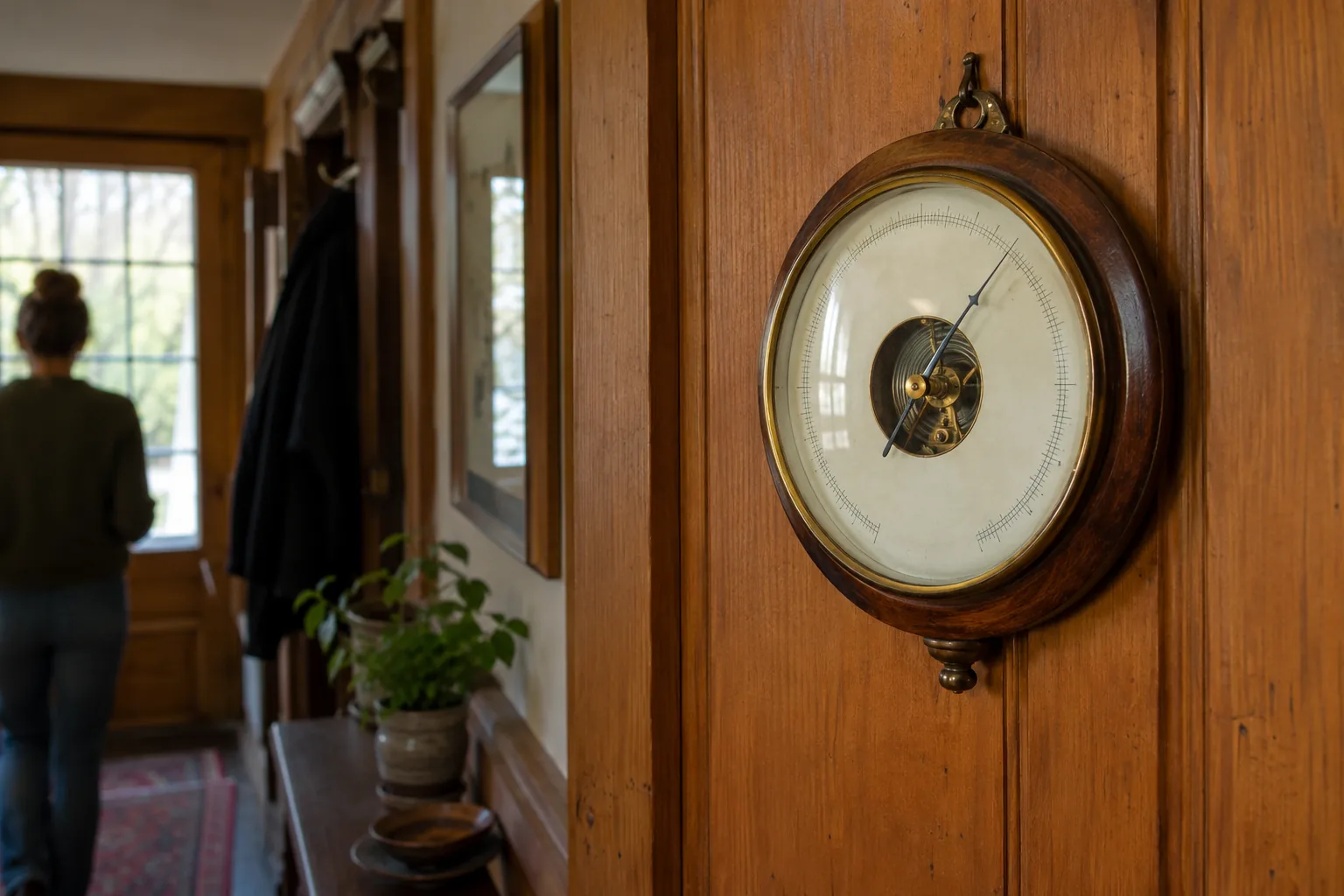
Units: What Barometric Pressure Is Measured In
You will meet several units, and some meters let you switch between them. Average pressure at sea level is about 1013 hPa, which equals 1013 millibars or about 29.92 inHg.
| Unit | Short form | Typical sea-level value | Where you see it |
|---|---|---|---|
| Hectopascal | hPa | about 1013 | Digital meters, international forecasts |
| Millibar | mb | about 1013 | Weather maps, same size as hPa |
| Inches of mercury | inHg | about 29.92 | US forecasts, aviation, older barometers |
| Kilopascal | kPa | about 101.3 | Engineering and science |
One hectopascal and one millibar are the same amount, so a reading in either needs no conversion. Pick one unit and keep it, so your readings stay comparable from day to day.
High vs Low Pressure: What the Numbers Mean
No single threshold is exact, because local weather and elevation shift the picture. As a rough guide at sea level, readings near 1013 hPa are average, readings well above that point to high pressure, and readings well below it point to low pressure.
What is considered high air pressure
Pressure above roughly 1022 hPa (30.2 inHg) is generally counted as high. High pressure usually goes with settled, clearer skies because the air is sinking. A higher barometric pressure means the air overhead is sinking and drier weather is more likely.
What is considered low
Pressure below roughly 1009 hPa (29.8 inHg) is generally counted as low. Rising air forms clouds, so low pressure goes with unsettled weather.
| Reading at sea level | Label | Typical sky |
|---|---|---|
| Above about 1022 hPa | High | Clear or fair |
| About 1009 to 1022 hPa | Average | Mixed |
| Below about 1009 hPa | Low | Cloudy, wet or windy |
Is barometric pressure high or low when it rains?
Rain usually arrives with low or falling pressure. A deep, fast drop often goes with a more active system, while a steady rise suggests clearing. Take these as tendencies and check the sky too.
Reading the Trend on a Handheld Meter
The trend matters more than the number. A reading of 1012 hPa that was 1018 hPa three hours ago says something different from 1012 hPa that was 1006 hPa. Follow these steps:
- Note the reading and the time, or let the meter log it.
- Check again after a few hours, keeping the meter at a similar height.
- Compare: rising means improving weather, falling means worsening, flat means little change.
- Look at wind, cloud and temperature before you decide.
The AltiPeak handheld altimeter and weather station follows pressure over time and shows the trend as a simple forecast icon. Its built-in thermometer feeds the pressure reading, and the integrated carabiner clips it to a pack. Because it is a trend indicator, read the icon alongside what you can see in the sky.
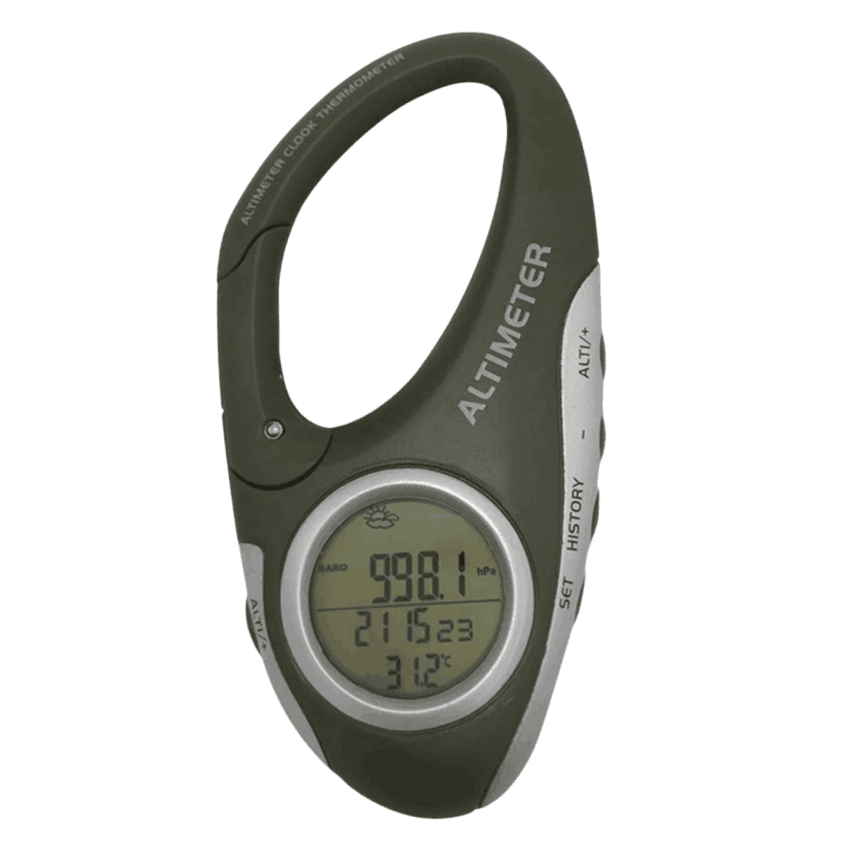 In this guideAltiPeak$89.99View
If you also want wind in the same reading, the ZephyrAxis wind gauge meter pairs an impeller for wind speed, gusts and averages with an external thermistor probe and a solid-state barometer that logs pressure change. The screen shows whether pressure is rising or falling next to the wind and temperature values. For how wind and temperature combine, see Wind Chill Factor.
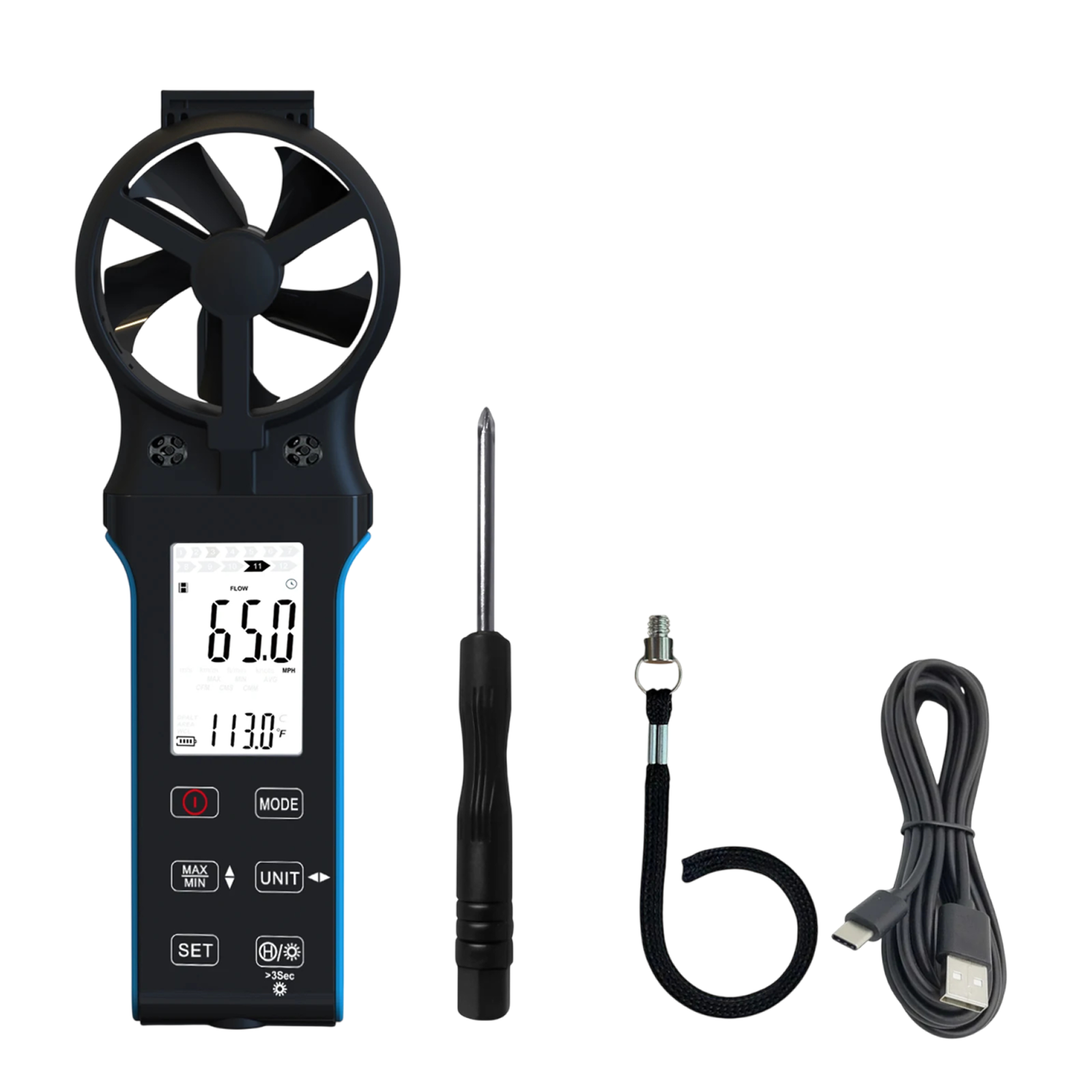 In this guideZephyrAxis$99.99View
How Altitude Changes the Reading
There is less air above you the higher you go, so pressure falls with elevation. That is why a barometric altimeter works: it reads pressure and converts it to height. If you wonder what is a barometric altimeter, it is a pressure sensor with that conversion built in.
The catch is that weather also moves pressure. A storm passing while you stand still can shift an altitude reading, so a barometric altimeter needs a known starting point. With the AltiPeak, you set the starting elevation at a known point, such as a trailhead sign or a marked summit, then check readings with one button.
Station pressure vs sea-level pressure
Weather reports give pressure adjusted to sea level so places at different heights can be compared. A meter at the ground in a mountain town shows the raw local value, which is lower. If you want to compare your meter to a forecast, enter your elevation or use the meter's reference setting if the manual lists one.
Temperature adds a second variable. The AltiPeak's built-in thermometer measures air temperature and factors it into the pressure reading, so the unit uses both inputs when it works out altitude.

Setup Checklist and Common Mistakes
- Set a known elevation before a hike, then reset it at the next marked point.
- Keep the meter out of direct sun and away from your body heat when you can, since heat skews temperature input.
- Do not blow on the sensor or cover its port.
- Compare readings taken at the same height; carrying a meter up a staircase changes it.
- Charge or replace the battery before a trip, and follow the manual.
- Wipe the meter after use and store it dry.
For logging conditions over days at a fixed spot, Data Logger for Temperature and Humidity covers setup and use. You can also browse the Weather, Air & Moisture Meters collection for other instruments.
Field note
Write down one reading in the morning and one in the afternoon. A change of a few hectopascals across the day shows a clearer trend than staring at a single number.
Quick Reference
Remember three points. Average sea-level pressure is about 1013 hPa. Falling pressure points to unsettled weather, rising pressure to clearing. And what is barometric pressure at a given place depends on elevation, so set a reference first. With those in hand, any barometer, from a glass-tube mercury barometer to a pocket digital unit, gives you a usable forecast.
Frequently asked questions
Keep reading
 Weather, Air & Moisture MetersWind Chill Factor: How to Work It Out From Wind and Temperature7 min read
 Inspection Cameras & ScopesVideo Borescopes: How They Work and How to Use One on a Car7 min read
 Weather, Air & Moisture MetersHow Does a Moisture Detector Work? Readings and What Skews Them9 min read