Wind Chill Factor: How to Work It Out From Wind and Temperature
Wind chill factor combines air temperature and wind speed into one "feels like" number. Measure both yourself, apply the standard formula or the lookup table below, and you have the value.
The Quindrel Team
October 23, 2026 · 7 min read

The wind chill factor is a "feels like" temperature that combines air temperature and wind speed into one number. You work it out from two readings: air temperature in degrees Fahrenheit and wind speed in miles per hour. This guide shows how to take both readings, run the formula, and check your answer against a lookup table.
A forecast gives you one number for a whole area. Your own readings reflect the spot where you are working, whether that is a driveway, a job site or an open field.
What the wind chill factor tells you
Air at a given temperature feels colder when it moves. Moving air carries more heat away from exposed skin than still air does, so the wind chill temperature is always at or below the plain air temperature when the formula applies.
Wind chill is not a temperature a thermometer can read. A thermometer, or a car engine, sits at the air temperature no matter how hard the wind blows. The number describes how the conditions feel to a person, which is why it matters for planning clothing and outdoor work, not for predicting whether water freezes.
When the formula applies
The standard formula is built for air temperatures at or below 50°F and wind speeds above 3 mph. Outside that range, the result is not valid. In calm air or mild weather, the air temperature is the number to use.
The wind chill formula, step by step
The standard US formula uses temperature (T, in °F) and wind speed (V, in mph):
Wind chill = 35.74 + 0.6215T − 35.75(V^0.16) + 0.4275T(V^0.16)
The part that looks odd is V^0.16, which means wind speed raised to the 0.16 power. Any calculator with an x^y key handles it, including a phone calculator in landscape mode. For a classroom-style walk-through of the same equation, see a page on the wind chill formula.
- Measure the air temperature in °F. If you have °C, multiply by 9, divide by 5, then add 32.
- Measure the wind speed in mph. If your meter shows km/h, multiply by 0.621. If it shows m/s, multiply by 2.237.
- Calculate V^0.16 once and write it down.
- Plug the numbers into the formula and round to the nearest whole degree.
Worked example: 20°F and a 15 mph wind
First, 15^0.16 is about 1.542. Then 35.74 + (0.6215 × 20) = 48.17. Next, 35.75 × 1.542 = 55.13. Finally, 0.4275 × 20 × 1.542 = 13.19.
Put together: 48.17 − 55.13 + 13.19 = 6.23, so the wind chill temperature rounds to 6°F. The air is 20°F, but the exposed-skin conditions match a calm 6°F day.

Measure wind speed and air temperature yourself
The formula is only as good as the two inputs. A handheld wind speed meter reads the wind where you stand, and a separate temperature probe reads the air without the warmth of your hand or a car engine getting in the way.
What a handheld meter should give you
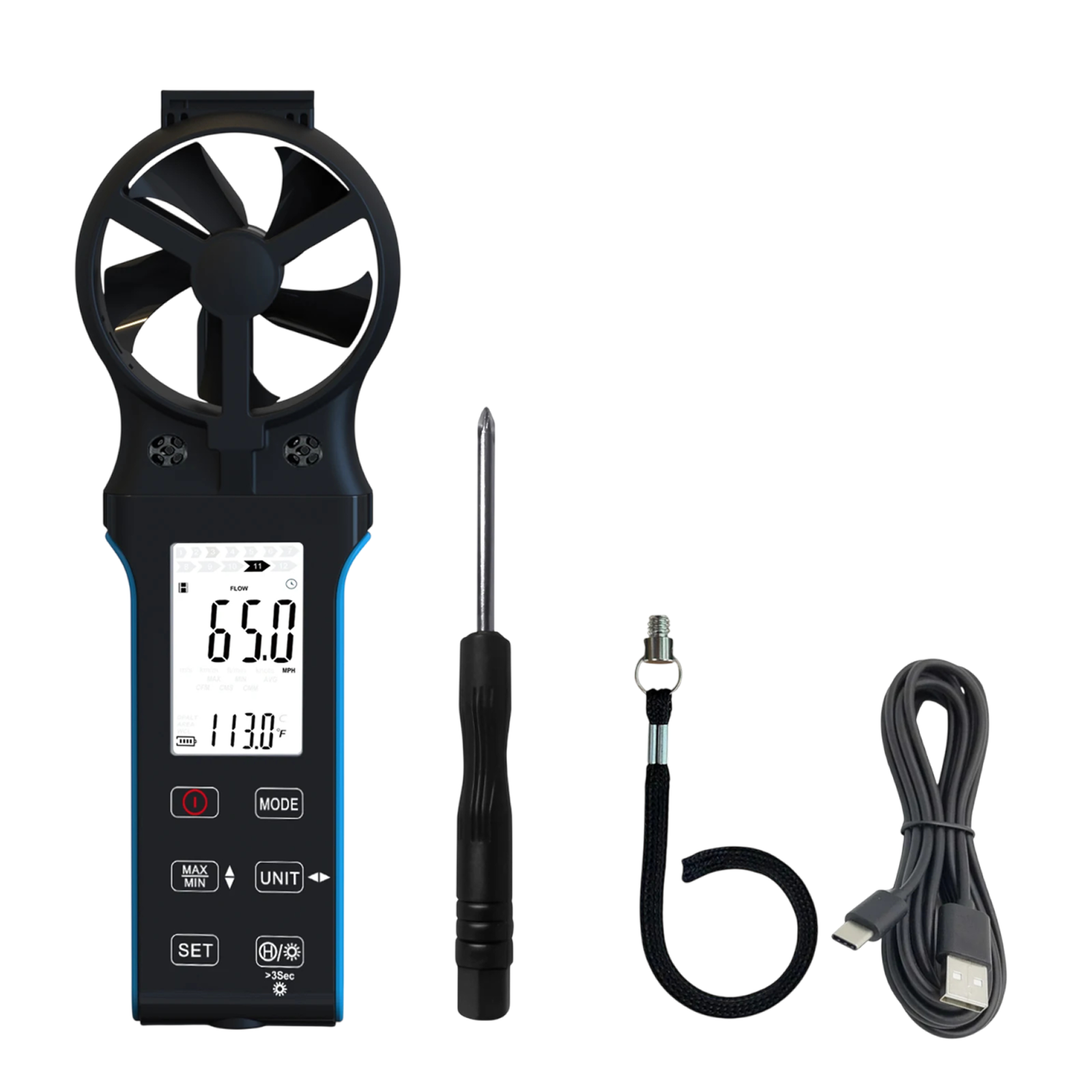
For wind chill you need three things: wind speed, a gust reading, and air temperature. ZephyrAxis is a handheld wind gauge meter with an impeller that reads wind speed, gusts and averages, plus an external thermistor probe for air temperature. The probe sits out in the airflow instead of inside the device body, which keeps the temperature sensor away from the heat of the housing and your hand.
All values show together on the backlit screen, so you can read speed and temperature in one glance and go straight to the formula. The solid-state barometer also logs pressure change, and the screen shows whether pressure is rising or falling, which helps you follow changing conditions through the day.
 In this guideZephyrAxis$99.99View
The meter is rechargeable by USB-C, and a hand strap is included. The housing is sealed and the controls are moisture-resistant; wipe it down after use and store it dry with the strap attached. If you want to compare it with other instruments, browse the Weather, Air & Moisture Meters collection.
How to take a clean reading
- Stand in the open, away from walls, vehicles and fences that bend the airflow.
- Hold the meter into the wind so the impeller turns freely.
- Keep the temperature probe in the moving air, out of direct sun and away from your body.
- Use the average wind speed for the formula, and note the gust value separately.
- Take several readings over a short period, since wind changes from moment to moment.
Field note
Run the formula twice: once with the average wind speed and once with the gust speed. The gust result shows how the exposure feels during the strongest moments, which is useful when you plan how long to stay outside.
Wind chill lookup table
If you would rather skip the calculator, use this table. It was worked out from the same formula and rounded to the nearest degree. Find your air temperature in the left column, then read across to your wind speed.
| Air temp (°F) | 5 mph | 10 mph | 15 mph | 20 mph | 25 mph | 30 mph |
|---|---|---|---|---|---|---|
| 30 | 25 | 21 | 19 | 17 | 16 | 15 |
| 20 | 13 | 9 | 6 | 4 | 3 | 1 |
| 10 | 1 | −4 | −7 | −9 | −11 | −12 |
| 0 | −11 | −16 | −19 | −22 | −24 | −26 |
For readings between the rows, pick the nearest column, or run the formula for an exact value. The table agrees with the worked example above: 20°F with a 15 mph wind gives 6°F.
Reading the table
Look at how the drop behaves. At 20°F, the first 10 mph of wind takes the number from 20 down to 9, while the next 10 mph takes it from 9 down to 4. Early gains in wind speed change the result most, and each further increase adds less.
Common mistakes when working out wind chill
- Using the formula above 50°F or in wind of 3 mph or less. The result is not valid there.
- Entering km/h, m/s or °C into a formula built for mph and °F. Convert first.
- Reading the temperature with a probe held against your body, a warm vehicle or a sunlit wall.
- Using a single gust as the wind speed. Use the average, then check gusts separately.
- Reading the result as the air temperature. Engines, pipes, tires and fluids respond to the actual air temperature, not the wind chill.
- Taking a reading beside a building, where wind is blocked or funneled and does not match open ground.
For cold-weather work, follow the clothing and exposure advice that comes with your gear, and check local forecast warnings before heading out.
Wind chill today and tomorrow: your reading versus the forecast
Forecast pages answer "what is the wind chill today" for a wide area and give a single number, often based on conditions at a weather station. Your own reading answers it for your exact spot, which can differ near hills, buildings or open water.
For wind chill tomorrow, the forecast is the only source, since you cannot measure tomorrow's air. You can still use the formula on a forecast: take the predicted air temperature and wind speed and run the numbers. That lets you compare the temperature and wind chill together and plan which layers to pack.
The pressure trend on a barometer adds context. A falling trend suggests conditions are changing, so keep checking the wind speed and air temperature rather than relying on one early reading. Weather wind chill values from a forecast are a planning aid; your meter shows what is happening where you stand.
If you are comparing a phone app with a dedicated instrument for other readings, Sound Level Meter App vs Dedicated Meter explains how the two approaches differ in what they can measure.
Setup checklist
| Step | What to do |
|---|---|
| 1 | Charge the meter through the USB-C port with the included cable |
| 2 | Go to open ground and face into the wind |
| 3 | Read average wind speed, gusts and air temperature from the screen |
| 4 | Convert to mph and °F if needed |
| 5 | Use the table or the formula to find the temperature with wind chill |
| 6 | Wipe the meter and store it dry with the strap attached |
Keep a small notebook in your gear bag. Writing down the date, air temperature, wind speed and result builds a record you can compare against later forecasts.